


special project
Assemblage
of Complexity
of Complexity
Artists:
Yury Adomeyko, Atomic Province, an art collective, Ivan Belov, Dmitry Blokhintsev, Sergey Kolosov, Taisia Korotkova, Stefania Kudryavtseva, Oleg Kukushkin, Anastasia Pozhidaeva, Mikhail Romm, Katya Ryblova, Igor Sokolov-Petryanov, Viktor Shustin, Vladislav Solovyev, Fedor Telkov, Yury Tumanov, Kuzma Vladimirov, Regina Yafasova and Fedor Karpov
Assistant Curator:
Artur Knyazev
Scholarly Consultant:
Galina Orlova
Curator:
Kristina Romanova
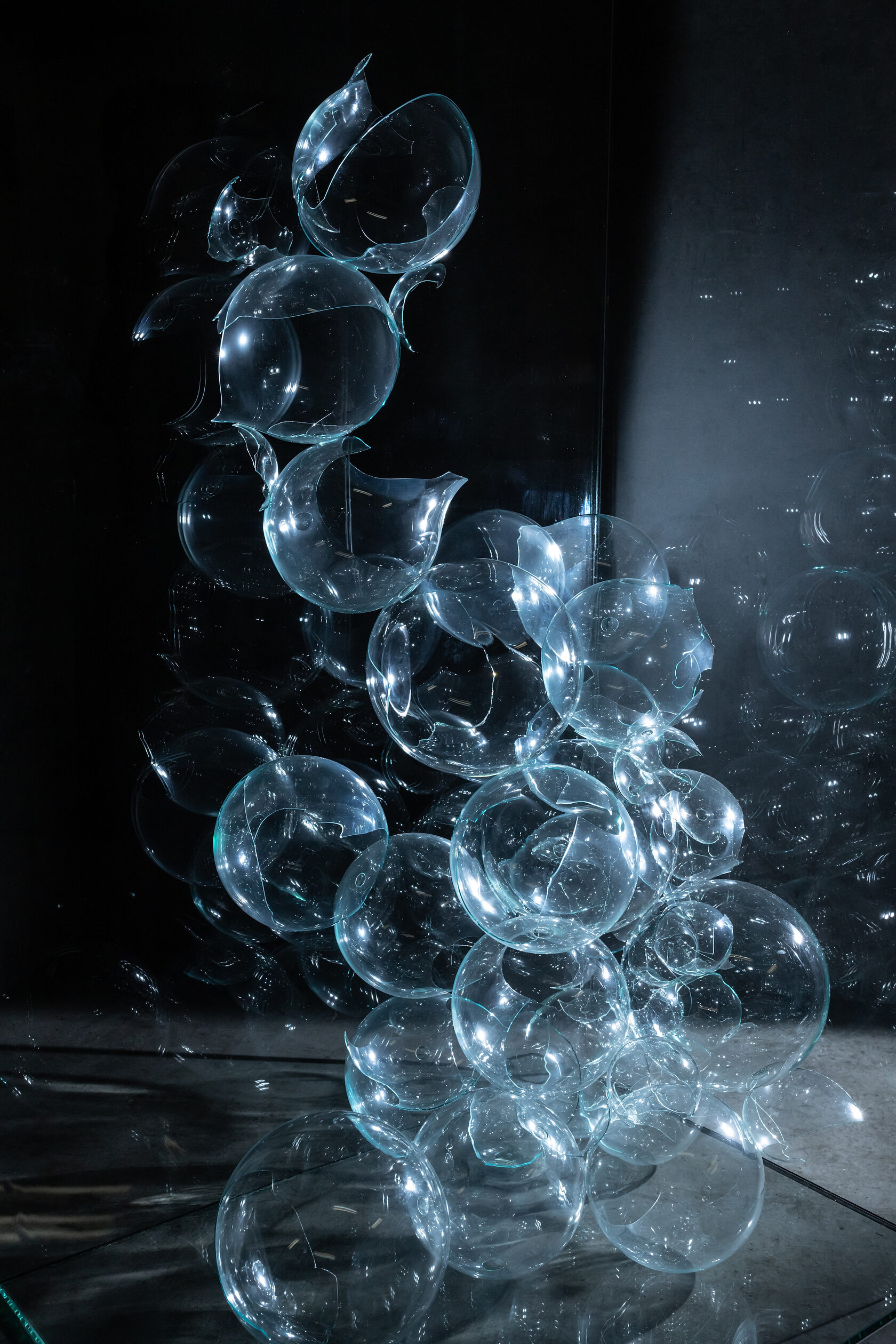
Assemblage of Complexity is an interdisciplinary exhibition and research project, conceived as part of the special program of the First International Biennial of Environmental Art and developed for the Mayak Academy. It comes in response to the tensions, paradoxes, and unresolved legacies of the atomic age — a period that has shaped the horizon of modernity for several generations.
By the early 1980s, thinkers at the forefront of nuclear critique had proposed that technologies capable of accessing intranuclear forces were so consequential that they altered the very production of meaning in language and culture.
“The exhibition brings to the forefront the relationship between industry and nature — both the local environment and nature in general, as well as the ‘nature of things’ themselves. The title, Assemblage of Complexity, refers partly to the population of industrial cities, and partly to the strange, intricate lives of people who worked in strictly controlled, high-security facilities, yet remained free, creative, and thoughtful individuals. For me, that is the most important aspect of the show,” noted Dmitry Khankin, managing partner of Triumph Gallery.
The exhibition’s title and curatorial trajectory evoke a multilayered synthesis of archival material and contemporary artistic practice, of documentary evidence and aesthetic reflection. The narrative moves from early enchantment with the monumental scale of ‘big science’ toward an awareness of the new forms of global inter dependence and responsibility that emerged in a world where humans learned to command the forces operating at the core of matter. This shift is articulated through a series of deliberate juxtapositions: artistic legacies from historic ‘atomic cities’ are placed in dialogue with scientific photography from nuclear laboratories; technological developments are framed alongside the lived histories of artists, physicists, and engineers. As these fragments are assembled into a single, complex constellation, three thematic movements take shape: Scale, Complexity, and Entanglement. The urban environment, shaped by the nuclear industry, is a continuous thread throughout the project.
“By presenting contemporaries’ and later generations’ reflections on the USSR’s mastery of nuclear energy as a subject of the exhibition, we aim to distinguish the dominant modes of display and exoticization, without being limited by them, leaving room for a complex mixture of words and objects, traces and destinies,” said Galina Orlova, scholarly consultant.
he exhibition brings together graphics, photography, objects, and installations by contemporary artists from Vladimir, Zarechny, Krasnoyarsk, Moscow, Nizhny Novgorod, and Sarov, alongside rare archival materials from municipal and federal collections in Dubna, Yekaterinburg, Obninsk, and Saint Petersburg. Visitors will be able to see paintings by the renowned theoretical physicist Dmitry Blokhintsev, the original 1967 poster “Let the Atom Be a Worker, Not a Soldier!”, sketches for the Beloyarsk Nuclear Power Plant logo (1990) by the art group Atomic Province, unique photographic archives by Yuri Tumanov from the High-Energy Physics Laboratory of the Joint Institute for Nuclear Research, and the personal photo archive of Vladislav Solovyov, chronicler of the first Russian “science city.”
“Eighty years of the domestic nuclear industry is a history of achievements in which there has always been room for creativity and humanistic reflection. The special project Assemblage of Complexity is a landmark event for us in this anniversary year. It is not merely an exhibition, but a profound dialogue between science, history, and contemporary art — a bridge connecting the past and present of the nuclear sector.
Unique artifacts and works by contemporary authors create precisely the ‘complex mixture’ of meanings that define the atomic era. We are pleased that the Mayak Academy has opened a space for such a multi-voiced and honest conversation about the industry’s path and its place in society. Through the lens of art and archival evidence, we see not only the heroic story of the early years but also its living, thoughtful continuation in the work of contemporary artists. Visitors to the exhibition will be able to engage with the spirit of the era, understand the multifaceted nature of our heritage, and see how the mission of peaceful nuclear energy, established 80 years ago, continues to inspire artists today,” emphasized Anna Zhigulskaya, Director of the Project Office for Internal Communications and CSR at the State Corporation Rosatom.
A specially recorded audio guide, based on an expert essay, will serve as a guide through the complex and sometimes contradictory fabric of these reflections.
By the early 1980s, thinkers at the forefront of nuclear critique had proposed that technologies capable of accessing intranuclear forces were so consequential that they altered the very production of meaning in language and culture.
“The exhibition brings to the forefront the relationship between industry and nature — both the local environment and nature in general, as well as the ‘nature of things’ themselves. The title, Assemblage of Complexity, refers partly to the population of industrial cities, and partly to the strange, intricate lives of people who worked in strictly controlled, high-security facilities, yet remained free, creative, and thoughtful individuals. For me, that is the most important aspect of the show,” noted Dmitry Khankin, managing partner of Triumph Gallery.
The exhibition’s title and curatorial trajectory evoke a multilayered synthesis of archival material and contemporary artistic practice, of documentary evidence and aesthetic reflection. The narrative moves from early enchantment with the monumental scale of ‘big science’ toward an awareness of the new forms of global inter dependence and responsibility that emerged in a world where humans learned to command the forces operating at the core of matter. This shift is articulated through a series of deliberate juxtapositions: artistic legacies from historic ‘atomic cities’ are placed in dialogue with scientific photography from nuclear laboratories; technological developments are framed alongside the lived histories of artists, physicists, and engineers. As these fragments are assembled into a single, complex constellation, three thematic movements take shape: Scale, Complexity, and Entanglement. The urban environment, shaped by the nuclear industry, is a continuous thread throughout the project.
“By presenting contemporaries’ and later generations’ reflections on the USSR’s mastery of nuclear energy as a subject of the exhibition, we aim to distinguish the dominant modes of display and exoticization, without being limited by them, leaving room for a complex mixture of words and objects, traces and destinies,” said Galina Orlova, scholarly consultant.
he exhibition brings together graphics, photography, objects, and installations by contemporary artists from Vladimir, Zarechny, Krasnoyarsk, Moscow, Nizhny Novgorod, and Sarov, alongside rare archival materials from municipal and federal collections in Dubna, Yekaterinburg, Obninsk, and Saint Petersburg. Visitors will be able to see paintings by the renowned theoretical physicist Dmitry Blokhintsev, the original 1967 poster “Let the Atom Be a Worker, Not a Soldier!”, sketches for the Beloyarsk Nuclear Power Plant logo (1990) by the art group Atomic Province, unique photographic archives by Yuri Tumanov from the High-Energy Physics Laboratory of the Joint Institute for Nuclear Research, and the personal photo archive of Vladislav Solovyov, chronicler of the first Russian “science city.”
“Eighty years of the domestic nuclear industry is a history of achievements in which there has always been room for creativity and humanistic reflection. The special project Assemblage of Complexity is a landmark event for us in this anniversary year. It is not merely an exhibition, but a profound dialogue between science, history, and contemporary art — a bridge connecting the past and present of the nuclear sector.
Unique artifacts and works by contemporary authors create precisely the ‘complex mixture’ of meanings that define the atomic era. We are pleased that the Mayak Academy has opened a space for such a multi-voiced and honest conversation about the industry’s path and its place in society. Through the lens of art and archival evidence, we see not only the heroic story of the early years but also its living, thoughtful continuation in the work of contemporary artists. Visitors to the exhibition will be able to engage with the spirit of the era, understand the multifaceted nature of our heritage, and see how the mission of peaceful nuclear energy, established 80 years ago, continues to inspire artists today,” emphasized Anna Zhigulskaya, Director of the Project Office for Internal Communications and CSR at the State Corporation Rosatom.
A specially recorded audio guide, based on an expert essay, will serve as a guide through the complex and sometimes contradictory fabric of these reflections.