


special project
apiarian zone
There are approximately twenty thousand species of bees in the world, yet many have nearly vanished in recent decades. Their decline carries potentially irreversible consequences — from the loss of roughly one-third of our food supply and numerous medicines to the severe impoverishment of flora without pollination.
In the collaborative project Apiarian Zone by Maria Safronova and Anton Kuznetsov, the life of bees is examined as a metaphor for contemporary society: human cultural and social patterns find direct parallels in the world of these insects. The project also looks toward the near future, envisioning dystopian scenarios tied to irreversible ecological changes. These threads intertwine in the works of Safronova and Kuznetsov, reflecting different aspects of human-bee interaction: delicate connections, boundaries of contact, and mutual dependence.
Bees are considered not only as a symbol of a complex ecological balance but also as part of an ecosystem that reflects nature’s vulnerability in the Anthropocene. The artists emphasize the importance of harmonious coexistence between humans and nature. Their works encourage reflection on how natural ecosystems might develop under technocratic pressures and serve as a reminder of the need to rethink humanity’s relationship with the environment.
Maria Safronova is known for her paintings that explore social institutions humans traverse in life — kindergartens, schools, hospitals, workplaces. Her series in this exhibition draws numerous parallels between bee communities and human society, revealing similarities across different structures — from the organization of homes to public institutions. Central to her work is the relationship between humans and nature, between humans and other species, and between people themselves.
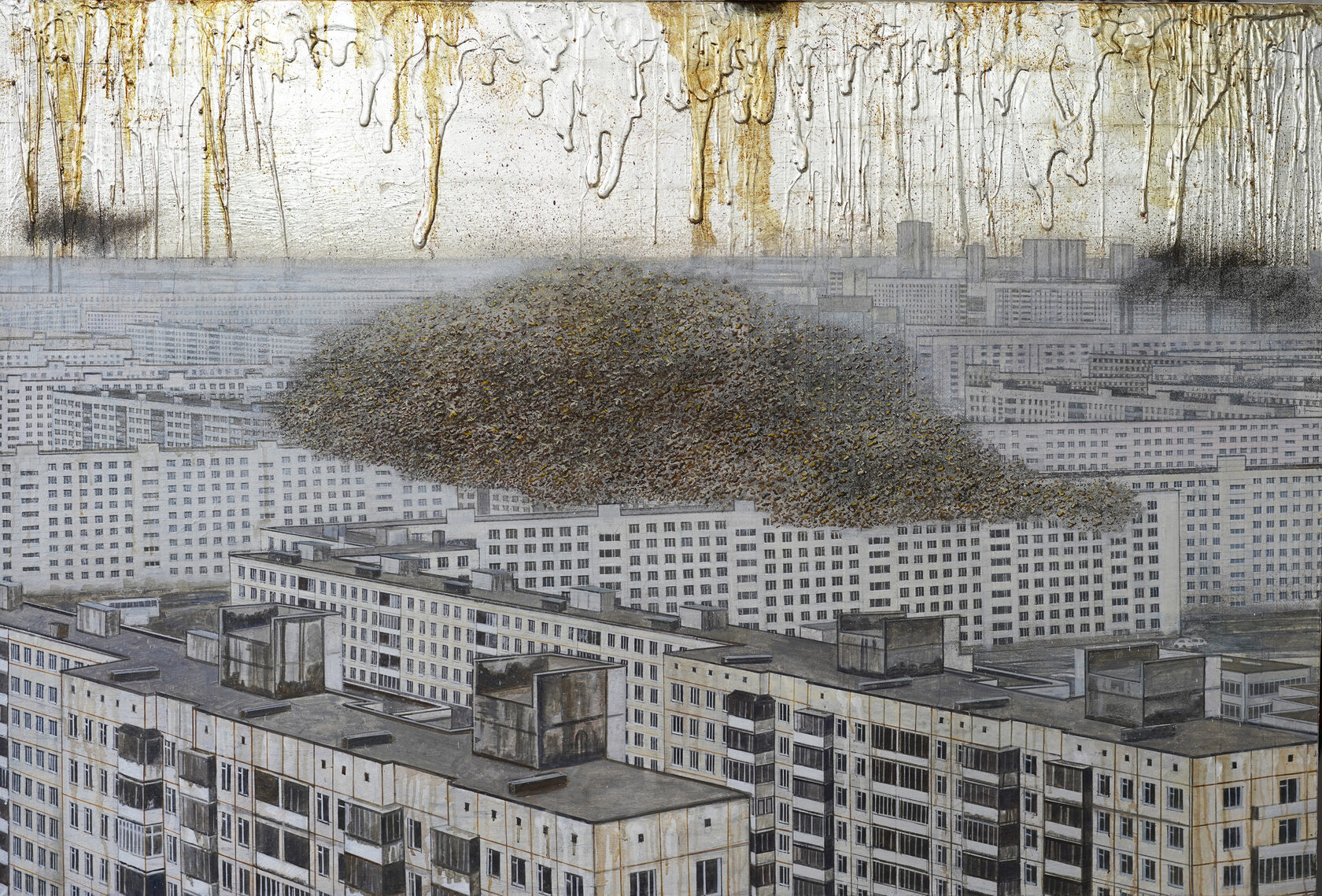
Anton Kuznetsov addresses the interplay of humans, technology, and nature. By solving problems with various devices, humans effectively prosthetize the natural environment, yet technology often generates new challenges. In Kuznetsov’s paintings and installations, a hypothetical future is depicted in which humans must replace bees with machines: drones fly over melting glaciers, natural hives are supplanted by industrial factories, and fields transform into artificial plant-growing facilities.
The project is presented in two parts: an exhibition in the assembly hall and foyer, and an artistic intervention in the halls of the Nizhny Novgorod State Art Museum. The path to the exhibition passes through the museum’s main collection, within which Safronova’s and Kuznetsov’s works are integrated. By observing individual pieces by masters from different eras, viewers can trace how humanity’s attitude toward nature has evolved over centuries and how this evolution has been reflected in visual art. Works by contemporary artists and historical masters thus enter into dialogue, allowing the audience to witness the unfolding of the exhibition’s central theme.
_______
Maria Safronova was born in Rzhev in 1979. She studied at the Moscow State Academic Art Institute named after V. I. Surikov, later continuing her training at the Institute of Contemporary Art Problems and the Free Workshops School of Contemporary Art. Her work, which often explores social institutions and human communities, has received wide recognition: she was a finalist for the Kandinsky Prize in 2012 and a nominee in 2014, 2017, and 2021, and in 2021 she was also nominated for the Innovation Prize. In 2015, she received the Sergey Kuryokhin Prize for “Best Work of Visual Art,” and her contributions to contemporary art have been recognized through nominations for the Moscow Art Prize (2020) and NordArt 2021 in Germany. Safronova’s works are included in major museum collections, including the Moscow Museum of Modern Art, the Sergey Kuryokhin Center for Contemporary Art in Saint Petersburg, the National Art Gallery Khazine in Kazan, the Novosibirsk State Art Museum, the Museum Center Peace Square in Kaliningrad, and the Russian Arts Center, as well as in the National Museum of Women and Children in Beijing, prominent corporate collections, and numerous private collections in Russia and abroad.
Anton Kuznetsov was born in 1973 in Kazan. He graduated from the Moscow State Academic Art Institute named after V. I. Surikov and continued his studies at the Institute of Contemporary Art Problems and Free Workshops. His practice examines the intersection of humans, technology, and nature, envisioning both contemporary realities and possible futures. Kuznetsov participated in the MuseumsQuartier 21 residency in Vienna in 2014 and has been recognized with nominations for the Sergey Kuryokhin Prize (2015) and the Moscow Art Prize (2020). His works are held in the Russian Museum, the Moscow Museum of Modern Art, the National Art Gallery Khazine in Kazan, the Museum Center Peace Square in Kaliningrad, the Novosibirsk State Art Museum, as well as in private collections across Russia and internationally.
In the collaborative project Apiarian Zone by Maria Safronova and Anton Kuznetsov, the life of bees is examined as a metaphor for contemporary society: human cultural and social patterns find direct parallels in the world of these insects. The project also looks toward the near future, envisioning dystopian scenarios tied to irreversible ecological changes. These threads intertwine in the works of Safronova and Kuznetsov, reflecting different aspects of human-bee interaction: delicate connections, boundaries of contact, and mutual dependence.
Bees are considered not only as a symbol of a complex ecological balance but also as part of an ecosystem that reflects nature’s vulnerability in the Anthropocene. The artists emphasize the importance of harmonious coexistence between humans and nature. Their works encourage reflection on how natural ecosystems might develop under technocratic pressures and serve as a reminder of the need to rethink humanity’s relationship with the environment.
Maria Safronova is known for her paintings that explore social institutions humans traverse in life — kindergartens, schools, hospitals, workplaces. Her series in this exhibition draws numerous parallels between bee communities and human society, revealing similarities across different structures — from the organization of homes to public institutions. Central to her work is the relationship between humans and nature, between humans and other species, and between people themselves.
Anton Kuznetsov addresses the interplay of humans, technology, and nature. By solving problems with various devices, humans effectively prosthetize the natural environment, yet technology often generates new challenges. In Kuznetsov’s paintings and installations, a hypothetical future is depicted in which humans must replace bees with machines: drones fly over melting glaciers, natural hives are supplanted by industrial factories, and fields transform into artificial plant-growing facilities.
The project is presented in two parts: an exhibition in the assembly hall and foyer, and an artistic intervention in the halls of the Nizhny Novgorod State Art Museum. The path to the exhibition passes through the museum’s main collection, within which Safronova’s and Kuznetsov’s works are integrated. By observing individual pieces by masters from different eras, viewers can trace how humanity’s attitude toward nature has evolved over centuries and how this evolution has been reflected in visual art. Works by contemporary artists and historical masters thus enter into dialogue, allowing the audience to witness the unfolding of the exhibition’s central theme.
_______
Maria Safronova was born in Rzhev in 1979. She studied at the Moscow State Academic Art Institute named after V. I. Surikov, later continuing her training at the Institute of Contemporary Art Problems and the Free Workshops School of Contemporary Art. Her work, which often explores social institutions and human communities, has received wide recognition: she was a finalist for the Kandinsky Prize in 2012 and a nominee in 2014, 2017, and 2021, and in 2021 she was also nominated for the Innovation Prize. In 2015, she received the Sergey Kuryokhin Prize for “Best Work of Visual Art,” and her contributions to contemporary art have been recognized through nominations for the Moscow Art Prize (2020) and NordArt 2021 in Germany. Safronova’s works are included in major museum collections, including the Moscow Museum of Modern Art, the Sergey Kuryokhin Center for Contemporary Art in Saint Petersburg, the National Art Gallery Khazine in Kazan, the Novosibirsk State Art Museum, the Museum Center Peace Square in Kaliningrad, and the Russian Arts Center, as well as in the National Museum of Women and Children in Beijing, prominent corporate collections, and numerous private collections in Russia and abroad.
Anton Kuznetsov was born in 1973 in Kazan. He graduated from the Moscow State Academic Art Institute named after V. I. Surikov and continued his studies at the Institute of Contemporary Art Problems and Free Workshops. His practice examines the intersection of humans, technology, and nature, envisioning both contemporary realities and possible futures. Kuznetsov participated in the MuseumsQuartier 21 residency in Vienna in 2014 and has been recognized with nominations for the Sergey Kuryokhin Prize (2015) and the Moscow Art Prize (2020). His works are held in the Russian Museum, the Moscow Museum of Modern Art, the National Art Gallery Khazine in Kazan, the Museum Center Peace Square in Kaliningrad, the Novosibirsk State Art Museum, as well as in private collections across Russia and internationally.
Марина Бобылева
Куратор: