


Special project
air
Curator:
Polina Mogilina
Artists:
Anatoly Akue, Ashesteen, Dima Retro, Konstantin ‘ZMOGK’ Danilov, Maksim Ima, Nootk, Misha Most.
On August 18, the Air project will open — a collaborative initiative with the Zen platform as part of the First International Biennale of Environmental Art in Nizhny Novgorod. Works by prominent artists Ashesteen, Maksim Ima, Misha Most, Anatoly Akue, Nootk, Konstantin “ZMOGK” Danilov, and Dima Retro will appear on building façades, city bridges, and in public parks. The Biennale is entirely devoted to reflecting on the relationship between humans and nature, and the Air project addresses issues such as air quality, space exploration, the consequences of human intrusion into near-Earth space, and the destruction of the planet’s biodiversity. The project was conceived and realized with the support of the Dzen platform.
The project’s title refers, on the one hand, to the very nature of street art, which traditionally exists outside the walls of galleries, museums, and other enclosed spaces. This form of art is directly connected to the city — its landscape, architecture, rhythm, and pulse of life — to its very breath. On the other hand, air quality is one of the key indicators of quality of life, and air pollution represents one of the greatest threats facing the planet today.
The Dzen platform serves as the project’s official partner. Dzen regularly publishes content on environmental issues, including news, analysis, and expert opinions. To coincide with the launch of the Biennale, Dzen introduced a thematic channel titled Ecology, featuring current publications on environmental protection and sustainable development by popular bloggers, as well as Biennale-related news from the media.
Functioning as a form of public social intervention, street art challenges audiences through direct visual impact and encourages active engagement and awareness. Artistic works are often capable of making visible what is difficult to express in words. Visual metaphors of environmental fragility and the integration of human figures into the biosphere address the anthropogenic nature of climate change and the need for active efforts toward ecological sustainability — both on a societal level and in individual practice.
The Air project will be launched in two stages. The first five murals will appear in Nizhny Novgorod on August 18, with two additional works unveiled by mid-September.
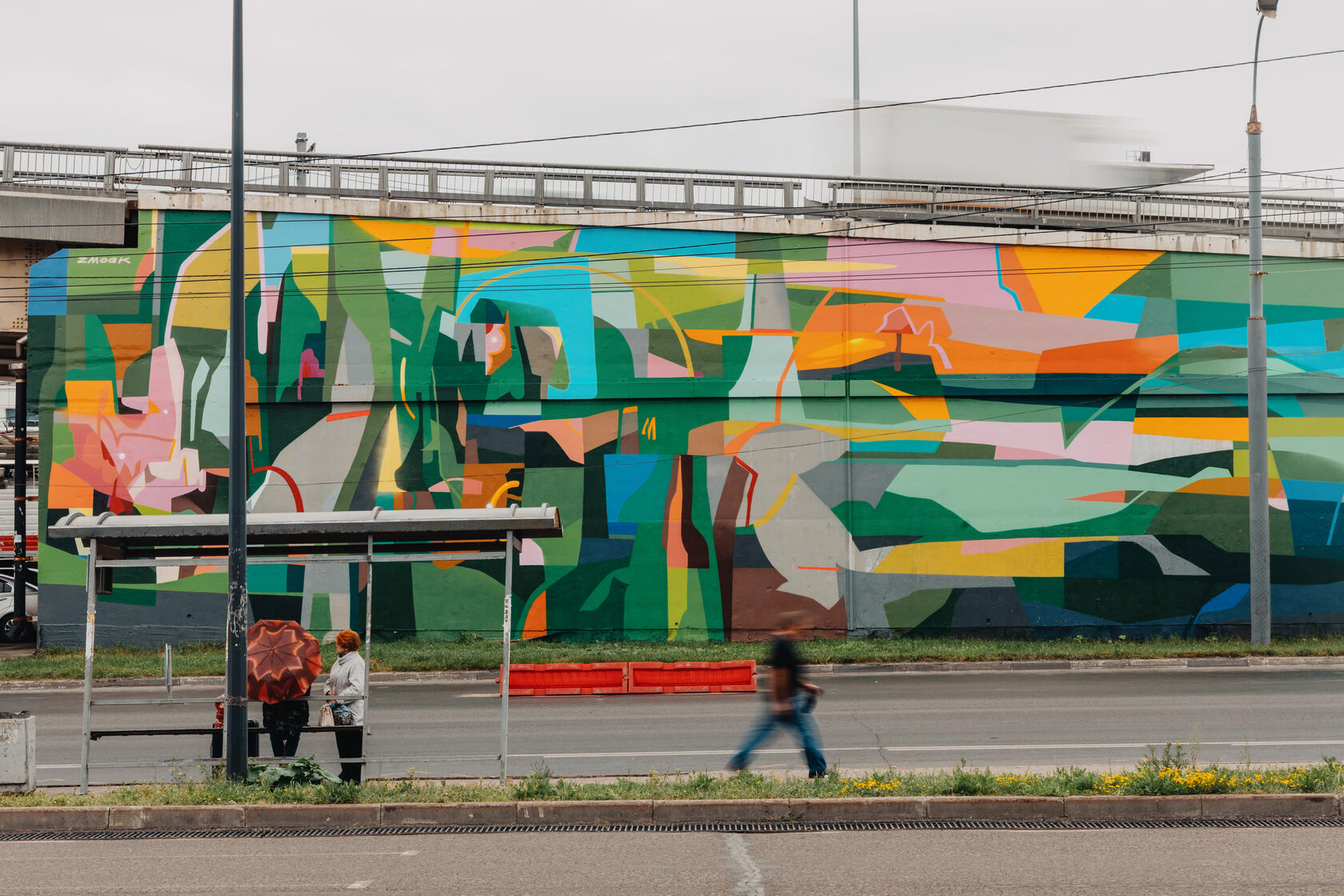
Ashesteen will present a work dedicated to air purity in the historic district (Korolenko Street, 11B). Air pollution remains one of the central issues of the global environmental agenda, as air quality affects the health of people in low-, middle-, and high-income countries alike. Misha Most addresses the issue of space debris resulting from near-Earth exploration (Kazanskoye Highway, 12/5). Currently, around 30,000 objects are orbiting the Earth. In his Layers of Disappearance mural(Moskovskoye Highway, 11B), Konstantin “ZMOGK” Danilov reflects on the destruction of biodiversity — from the green layer symbolizing the richness of living nature to gray voids and the texture of bare concrete.
Dima Retro painted a wall in Sverdlov Park, creating a composition based on a dense, dark vegetation pattern that gradually thins out. The idea suggests that people tend to notice what is disappearing rather than what is abundant, taking natural richness for granted. Maksim Ima draws attention to historical context in his work at 17 Pochaínskaya Street.
The image of a green ravine, beneath which a river flows through a collector, marks the downward direction of the street. A staircase is linked to a legend about a secret underground passage leading from one of the Kremlin towers to the Pochaina River.
During the second stage in September, works by Anatoly Akue and Nootk will appear in the city. In his mural (Zelensky Descent, 8), Anatoly Akue explores the complex issue of information storage through the image of a heated atmosphere, represented by a red background. A storage box on the right symbolizes cloud storage and interconnected data flows, while the contrast between hot and cold, chaotic and structured, creates a powerful internal dissonance. Nootk will paint the retaining wall of the metro bridge (Marata Street, 4). The composition features animals and birds classified as “0” and “A” in the Red Book of the Nizhny Novgorod Region — species that are extinct or endangered.
The project’s title refers, on the one hand, to the very nature of street art, which traditionally exists outside the walls of galleries, museums, and other enclosed spaces. This form of art is directly connected to the city — its landscape, architecture, rhythm, and pulse of life — to its very breath. On the other hand, air quality is one of the key indicators of quality of life, and air pollution represents one of the greatest threats facing the planet today.
The Dzen platform serves as the project’s official partner. Dzen regularly publishes content on environmental issues, including news, analysis, and expert opinions. To coincide with the launch of the Biennale, Dzen introduced a thematic channel titled Ecology, featuring current publications on environmental protection and sustainable development by popular bloggers, as well as Biennale-related news from the media.
Functioning as a form of public social intervention, street art challenges audiences through direct visual impact and encourages active engagement and awareness. Artistic works are often capable of making visible what is difficult to express in words. Visual metaphors of environmental fragility and the integration of human figures into the biosphere address the anthropogenic nature of climate change and the need for active efforts toward ecological sustainability — both on a societal level and in individual practice.
The Air project will be launched in two stages. The first five murals will appear in Nizhny Novgorod on August 18, with two additional works unveiled by mid-September.
Ashesteen will present a work dedicated to air purity in the historic district (Korolenko Street, 11B). Air pollution remains one of the central issues of the global environmental agenda, as air quality affects the health of people in low-, middle-, and high-income countries alike. Misha Most addresses the issue of space debris resulting from near-Earth exploration (Kazanskoye Highway, 12/5). Currently, around 30,000 objects are orbiting the Earth. In his Layers of Disappearance mural(Moskovskoye Highway, 11B), Konstantin “ZMOGK” Danilov reflects on the destruction of biodiversity — from the green layer symbolizing the richness of living nature to gray voids and the texture of bare concrete.
Dima Retro painted a wall in Sverdlov Park, creating a composition based on a dense, dark vegetation pattern that gradually thins out. The idea suggests that people tend to notice what is disappearing rather than what is abundant, taking natural richness for granted. Maksim Ima draws attention to historical context in his work at 17 Pochaínskaya Street.
The image of a green ravine, beneath which a river flows through a collector, marks the downward direction of the street. A staircase is linked to a legend about a secret underground passage leading from one of the Kremlin towers to the Pochaina River.
During the second stage in September, works by Anatoly Akue and Nootk will appear in the city. In his mural (Zelensky Descent, 8), Anatoly Akue explores the complex issue of information storage through the image of a heated atmosphere, represented by a red background. A storage box on the right symbolizes cloud storage and interconnected data flows, while the contrast between hot and cold, chaotic and structured, creates a powerful internal dissonance. Nootk will paint the retaining wall of the metro bridge (Marata Street, 4). The composition features animals and birds classified as “0” and “A” in the Red Book of the Nizhny Novgorod Region — species that are extinct or endangered.